Save 15% on your first session
The Enneagram
Understanding yourself and others to nurture deeper, healthier relationships.
History of the Enneagram
The Enneagram has ancient roots and a modern psychological application. While its exact origins cannot be traced to a single source, its wisdom appears to draw from early spiritual traditions in the Middle East, including elements of Christian mysticism, Jewish Kabbalah, Sufism, and ancient philosophy. For centuries, it functioned as a symbolic system for understanding human nature and transformation.
In the early 20th century, the Enneagram symbol was introduced to the modern world by George Gurdjieff, who taught it as a dynamic map of human processes and consciousness rather than a personality system.
The Enneagram began to take its current form in the 1950s–1970s through the work of Oscar Ichazo, who articulated the nine personality types and linked them to core motivations, fixations, and paths of growth. His work emphasized self-observation and inner transformation.
Later, psychiatrist Claudio Naranjo integrated Ichazo’s teachings with modern psychology, psychiatry, and therapeutic practice. Through Naranjo and his students, the Enneagram entered the fields of counseling, psychology, and personal development.
By the late 20th century, the Enneagram gained widespread use in psychotherapy, spiritual direction, leadership development, and organizational consulting. Today, it is valued not merely as a personality typology, but as a framework for self-awareness, emotional intelligence, relational health, and intentional growth.
The enduring power of the Enneagram lies in its unique ability to bridge ancient wisdom and modern application, offering insight not only into behavior, but into the deeper motivations that shape how people think, relate, lead, and live.
What Is the Enneagram?
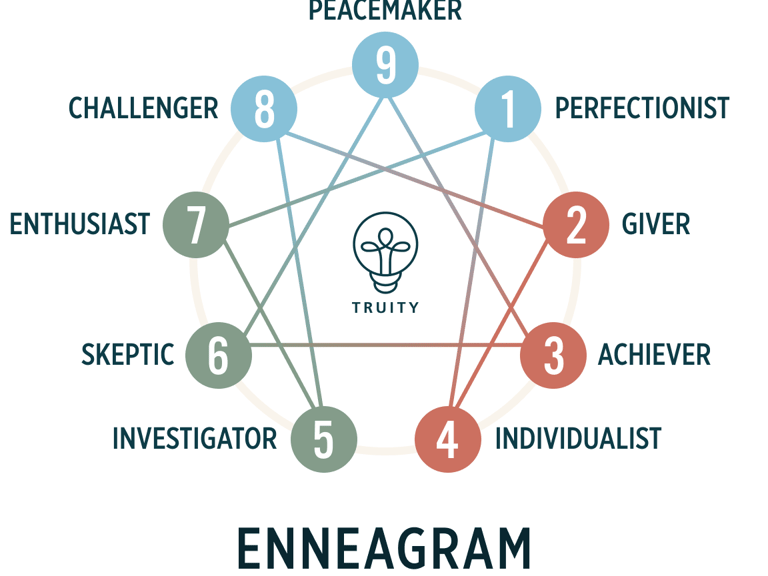
The Enneagram is a powerful, evidence-informed personality system that describes nine core personality types, each with distinct motivations, strengths, stress responses, and relational patterns. Unlike surface-level personality tools, the Enneagram focuses on why we think, feel, and act the way we do, not just what we do.
At its core, the Enneagram provides a roadmap for:
Self-awareness and emotional intelligence
Personal growth and healing
Healthier communication and relationships
Leadership development and team effectiveness
When used skillfully, the Enneagram becomes a transformational tool, helping individuals and organizations move from automatic patterns to intentional, values-driven living and leadership.
Enneagram vs Myers-Briggs
The Myers-Briggs Type Indicator (MBTI) and the Enneagram are both widely used personality frameworks, but they differ in what they measure and how they support growth. MBTI focuses on how people think, process information, and make decisions, categorizing individuals into 16 types based on cognitive preferences and communication styles. The Enneagram, by contrast, explores why people think, feel, and behave the way they do, identifying nine core personality types rooted in underlying motivations, fears, and emotional patterns. While MBTI is primarily descriptive and helpful for understanding work styles and communication, the Enneagram is a developmental system that highlights stress responses, relational dynamics, and pathways for personal and interpersonal growth. Many individuals and organizations use both together, as MBTI clarifies mental processes, while the Enneagram offers deeper insight into emotional drivers and sustainable transformation.
What Is Individual Enneagram Coaching?
Individual Enneagram coaching is a personalized, growth-focused process that helps you understand your Enneagram type and apply it to real-life challenges. Coaching goes beyond typing—it explores how your personality patterns show up in stress, relationships, leadership, decision-making, and purpose.
Through one-on-one coaching, clients gain:
Deeper self-awareness and clarity
Insight into emotional triggers and coping strategies
Tools to break unhelpful patterns
Increased confidence, boundaries, and alignment
Practical strategies for growth rooted in your specific type
Coaching sessions are tailored to your goals—whether personal development, leadership effectiveness, faith integration, or relational health.
How Is Enneagram Coaching Useful for Couples?
Enneagram coaching for couples provides a shared language for understanding differences without blame or defensiveness. It helps partners recognize how each person’s personality, attachment needs, and stress responses interact—especially during conflict.
Couples benefit by:
Understanding each other’s core motivations and fears
Improving communication and emotional safety
Reducing recurring conflict patterns
Increasing empathy, patience, and connection
Strengthening intimacy and teamwork
By integrating Enneagram insight with relational frameworks (such as Emotion-Focused and attachment-based approaches), couples learn how to move from cycles of misunderstanding to secure, connected relationships.
What Enneagram Trainings Do We Offer for Organizations?
We offer customized Enneagram-based trainings and consultations for organizations, leadership teams, and staff. Trainings are designed to be practical, engaging, and directly applicable to workplace dynamics.
Common training offerings include:
Enneagram Foundations for Teams
Leadership Development & Executive Coaching
Communication & Conflict Management
Team Dynamics & Collaboration
Stress, Burnout, and Resilience
Employee Engagement & Retention
Enneagram-Informed Job Alignment & Role Design
Trainings can be delivered as workshops, retreats, leadership intensives, or ongoing consultation engagements.
How Is the Enneagram Beneficial for Organizations?
The Enneagram helps organizations move beyond generic leadership models to people-centered, sustainable performance. By understanding how different personality types function under pressure, organizations can proactively address issues that impact culture, morale, and productivity.
Organizational benefits include:
Stronger leadership self-awareness
Improved communication across teams
Reduced conflict and workplace tension
Increased engagement and job satisfaction
Better role alignment and performance outcomes
Healthier responses to change and stress
The result is a workplace culture that supports both people and performance.
Why the Enneagram?
The Enneagram stands apart because it addresses the inner world that drives behavior. It doesn’t label or limit—it illuminates patterns and offers pathways for growth. When used ethically and skillfully, the Enneagram fosters compassion, accountability, and transformation.
Whether used for personal growth, relationships, or organizational leadership, the Enneagram empowers individuals and systems to:
Grow with intention
Lead with awareness
Relate with empathy
Perform with integrity
The Enneagram isn’t about fixing what’s broken—it’s about unlocking what’s already within you.
Enneagram coaching opened my eyes to patterns in my relationships I never noticed before.
Amy K.


★★★★★
Connect
Questions? Reach out anytime.
Call or TEXT: (803) 919-9533
© 2025. All rights reserved.